Blog

Near-miss story – Nigel’s Tale

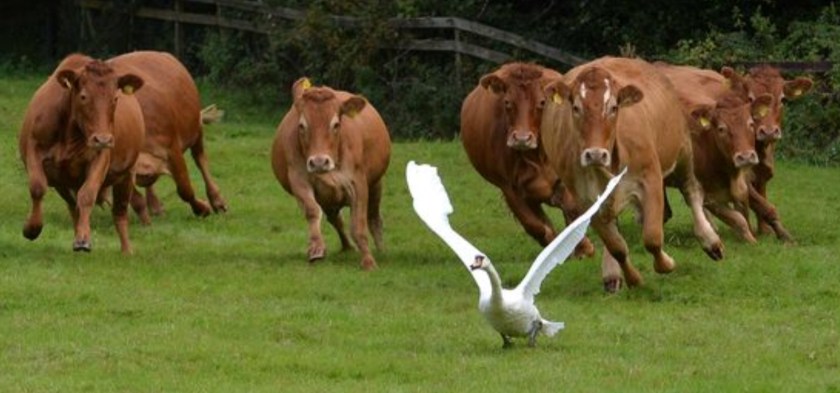
30-40 bullocks charged towards him at full gallop on the Pembrokeshire Coast Path

Last April, 2016, I had a frightening encounter with a group of bullocks in Pembrokeshire, Wales.

I was walking along the coastal path between Angle and Pembroke. It was a public footpath and well signposted. A herd of 30 or 40 bullocks slowly started to walk towards me. Then one broke into a trot and before long they were all charging towards me at a gallop.

There was nowhere I could escape to. The field was very large and long, with a hawthorn hedge and a steep drop into the sea on one side, and a high security fence on the other.

My only option was to run towards the cattle shouting and waving my arms.

Thankfully they stopped and I was able to walk away to safety. I dread to consider what would have happened if I had not decided on this option.

I didn’t see any warning signs when I entered the field, and I didn’t have a dog with me.

Luckily I wasn’t hurt, and I didn’t report the incident to anybody.  I do appreciate that farmland is there to be used by livestock, but it was very frightening, and since then I have become very cautious of cattle. They are very unpredictable.


Near-miss story – Maddi’s Tale

Maddi escaped by hiding under a tree. A terrifying experience.

In April this year, three of us were walking on a public footpath through Tring Park, in Herefordshire. There was a sign on a gate that warned us to be careful of cows, especially with dogs. We didn’t have a dog with us, so we weren’t particularly worried.

Suddenly, a herd of cows came over a hill and began running straight towards us. They had calves with them.

We ran away, but they chased us. To try to escape, we turned off the path and hid under a tree. The cows stopped on the path and began walking slowly towards us. They started to surround the tree. We were terrified.

Slowly, we started to walk away (instead of running). Thankfully they didn’t follow us.

When we got near the gate out of the field, and thinking we were safe, we stopped to talk. Suddenly, the cows suddenly started running at us again. We raced to the gate and managed to get away.

We didn’t have a dog with us, so there was no reason for the attack. I have no doubt that if we hadn’t got out of their way by hiding under the tree, they would have trampled us.

Luckily nobody was hurt, but we were badly frightened. Afterwards we reported it to the Woodland Trust (who own the park), but as far as we know there has been no further investigation.

More people should be aware of how dangerous cows can be. Possibly we need to fence off paths when they pass through a field of cattle.


Myth: There are 3 billion visits…

The 3 billion figure is used again and again. It is wrong. Just. Plain. Wrong.

Myth-busting: People make 3 billion visits to the English countryside every year

Err. No. They don’t.

This figure is used again and again, by official bodies, by journalists, and by other groups, but it is wrong. Just. Plain. Wrong.

Where does the 3 billion figure come from? It comes from the annual MENE surveys, which consistently show a figure of around 3 billion visits a year to outdoor spaces across England. Continue reading “Myth: There are 3 billion visits…”

Some facts and figures: When cattle attack…

What we can learn from 54 separate attacks by cattle on walkers.

Deaths and injuries to walkers caused by cattle – research findings.

Carri Westgarth and Marie McIntyre are both researchers from the University of Liverpool, and both have personal reasons to be interested in attacks by cattle. They recently completed a scoping exercise to determine the extent of the problem.

Looking for reports of cattle attacksWhat did they do? They searched newspaper reports published over a 20 year period, looking for reports of cattle attacks on walkers, including both deaths and injuries.

This is likely to be a huge underestimate of the true scale of the problem, because many attacks go unreported and unrecorded, but it’s a good start.

Here is a summary of their findings, published in 2016. They uncovered 54 separate attacks by cattle on walkers during the 20 year period. Continue reading “Some facts and figures: When cattle attack…”

Myth: Bulls chase the colour red.

Bulls don’t really care what colour you are wearing. Neither do cows.

“I’d advise not wearing red near bulls.”

Oh dear. You’ve been watching too many cartoons. This definitely is a myth.

Bulls don’t really care what colour you are wearing. Neither do cows. Cattle are virtually colour blind.

To be fair, there is some evidence cattle have limited colour receptors in their eyes, and might be able to distinguish red, although to them the colour red will look like a slightly different shade of grey.

It certainly isn’t true that bulls chase red objects and ignore the rest.

Then, why do they use red capes in a bull ring?

Bull holding a red cape and proving he is colour blindThe reason a bull will appear to chase a matador’s red cape in a bull ring, is because the animal is being threatened. He charges the thing he sees moving around. The cape.

The colour of the cape is irrelevant, as was demonstrated by using different colours in a Discovery Channel myth-busting experiment.

So bull’s don’t chase the colour red. There is really no need to keep repeating this myth. It’s just not true.

Neither will avoiding wearing the colour red keep you safe from bulls. That’s not true either.


Thank you to Pixabay for the images used on this page.
Header by OpenClipart-Vectors and cartoon by Clker-free-Vector-Images

Near-miss story – Maxwell’s Tweet

One man went walking with his dog. Next minute, he was running for his life.

One man went walking with his dog, and happened to enter a field of cows. Next minute, he was running for his life.

He captured the terrifying incident on his smart phone and, later, posted it on Twitter as a lesson to others.

“This happened at Pishiobury [near Welwyn Garden City]. I just cried and ran. My dog had to fend for himself. Literally the worst thing ever.”

Listen to it with the sound turned on.
Video on Twitter
Cattle attack, filmed on smartphone, posted to Twitter


Posted with the permission of @JMaxwell.

Cattle kill 6 a year in Northern Ireland

An experienced farmer describes how he was nearly gored.

Farmer Victor Chestnutt is deputy president of the Ulster Farmers’ Union and very aware of the need to handle cattle with caution. As part of Farm Safety Week, he described how he was nearly gored by one of his own cows a few years ago. Continue reading “Cattle kill 6 a year in Northern Ireland”

Do you know your cattle?

Three useful links to help you identify cattle after an attack.

When reporting a cattle incident, you may be asked to identify which breed was involved. If you don’t know your Aberdeen Angus from your Whitebred Shorthorn, here are some useful sites to help you decide.

10 Native British Cattle Breeds

A selection of the ten most common native breeds in the UK, from the excellent Countryfile team.

How to identify cattle after an attack
10 Native British Cattle Breeds: and how to recognise them.

Rare and Native Breeds Cattle

18 common and rare breeds found in the UK, supplied by the Rare Breeds Survival Trust (RBST) with links to further information on each one.

rare breeds of cattle - identify your cows and bulls 
Rare and Native Breeds Cattle

List of Cattle Breeds – Wikipedia

If you can’t find what you need above, Wikipedia lists 800 breeds of cattle, from around the world, including photographs of most of them.

wikipedia cattle index - to identify cows and bullsList of cattle breeds on Wikipedia

Don’t forget, you don’t need to be able to identify the breed before you report an incident to us, but it helps if you can.  Report an Incident here.


Featured photo credit: lydia harper

Near-miss Story – Ilse’s Tale

Ilse and her husband meet a bull on the narrow Pembrokeshire Coastal path.

I live in Belgium and was in Wales with my husband on a four-day hiking holiday along the famous Pembrokeshire Coastal Path. On the 13th July, 2017, we set off from Milford Haven, heading for a B&B in Dale. 

We were near St Ishmaels. There was just the two of us, and we didn’t have a dog. We had just passed some old bunkers, and the path was narrow with lots of shrubs. To the left was the cliff and the sea. To our right was a barbed wire fence and a meadow.

Suddenly we saw a bull. Behind him were several cows. They were right on the path. The bull was making a lot of noise.

 We were so frightened. Shaking like leaves.

 Luckily, there was a nearby gate, and we could escape through the gate and into the meadow. Safely on the other side of the fence, we took a photograph of the bull (see above).

 Suddenly, he turned around and went away, just as if he wanted to return back to the farm. Thinking it was safe, we left the meadow and started back along the path. To our horror, the bull and the cows returned. We were so scared, in shock, and almost paralysed by fear, but we managed to escape through the fence again.

Eventually the animals left. We were too frightened to go forwards, so we turned back and tried to make our way from there to St Ishmaels. We walked for miles and miles. Got lost. Eventually we had to catch a bus in order to get to our B&B in Dale.

 We weren’t injured, but we were very badly scared.

The strange thing about is that the bull and the cows were actually on the very narrow coastal path, and we had to escape into the meadow. It should have been the opposite way round!

 Suppose we had encountered the bull at another point, where the coast path then was even narrower, and where there was no fence to get safely behind? On our left side were cliffs. What would have happened?

 I didn’t report the problem at the time, but later I sent some pictures of the beautiful coast in Wales to http://www.pembrokeshirecoast.org.uk/ and I also sent the bull picture and our story of the bull in the neighbourhood of St Ishmael’s. I got an answer from a lady called Rebecca Evans, and she told me she will be meeting the farmer next week.

 As walkers, we know there is advice on how to walk across a large field with livestock, such as cows, bulls, ponies, etc. But being confronted by a bull and cows on a narrow path with no way out… what is the advice for that specific situation?


Featured Story – Anita’s Tale

Anita only survived because her dog raised the alarm.

I was 80 years old in September 2015, and very fit and active. I had planned to spend two weeks on a walking holiday in Northumbria with my daughter, Helen. We drove up from Lincolnshire, set up our camper van on the camp site, and decided to go for a walk.

We took our three dogs with us. I have a little Jack Russell. My daughter had a Border Collie (Meg) and a German Shepherd cross (Holly). Holly was a timid dog, frightened of cars, and little did we know that Holly was shortly going to save our lives.

We walked down a lane, crossed a busy road, and climbed over a high stile. The field was huge and seemed empty of livestock. In the distance was Hadrian’s Wall, and we thought it would be nice to follow the public footpath towards it.

Some way across the large field, we came upon a herd of black limousin cows and their brown-coloured calves. There were probably about 30 cows. They came towards us, bellowing and mooing loudly, making a terrible racket.

We dropped the leads so the dogs could run off. I can remember them hurtling past us and away from the cows. By this time we were a very long way from the stile, and along the side of the field was a barbed wire fence that I couldn’t climb over.

I caught my foot in a rut on the path and fell over, hitting my head. What happened next is a little vague, but I think the cows must have rolled me over, kicking my legs, because later I discovered my legs were covered in bruises.

I remember calling out to my daughter, Helen. I didn’t realise that one of the cows had tossed Helen and thrown her to the ground. Bravely, she picked herself up and came to help me. I was bleeding from my head. Blood everywhere.

Luckily, nearby, there was a feeder for calves. It was a big structure with bars that were wide enough for calves to get through, but not wide enough for cows. I couldn’t walk on my own. Helen dragged me over to the feeder and we crawled underneath it.

The cows surrounded the feeder, pushing their noses through the bars as if trying to get to us. They continued making a noise. We couldn’t stand up, just stayed crouching and sitting under the feeder, surrounded by cows.

This went on for over an hour. It was terrifying.

We later learnt what happened to the dogs. Meg (the Border Collie) got her lead caught on the stile on the way out of the field. Holly (the timid German Shepherd cross) somehow managed to cross the busy road and return to the campsite, where she raised the alarm by barking. People followed her, rescued Meg, and then realised there was a problem in the field with the cows.

The police arrived and a medic in a car. It took some effort on their part to shoo the cows away. I remember most of the cows eventually wandered off, but there was one cow who seemed to be the matriarch and was particularly aggressive. She was making the most noise. After a while, she gave up trying to attack us and followed the other cows up the field.

The medic had to crawl under the feeder to treat me. I had the cut on my head, but also had pins and needles in my arms. I thought the pins and needles were simply due to shock, but the medic put a collar around my neck.

I couldn’t get out from under the feeder, so people had to physically lift up the structure and move it, a few inches at a time, until I was free. I was placed on a stretcher and a helicopter arrived – an air ambulance. I remember the medics had to cut my clothes off and I was worried about getting cold.

The air ambulance took me to Newcastle Infirmary.

I have only vague memories of the next few days. Apparently they discovered I had a vertebral dislocation in my neck (between C5 and C6) and that was the cause of the pins and needles. By this stage, I couldn’t move my left arm. I was on traction for 4 days to try to remove the pressure on the nerves at the place where my neck was dislocated. The doctors needed to operate and told my children I could possibly become quadriplegic, and I might even die.

Luckily the operation was a success. I survived.

I was in Newcastle Infirmary for over five weeks. Because of the problem with my arms, I couldn’t look after myself and my daughter had to visit every day to look after me while I was in the hospital. She was still staying in the camper van, with three dogs to look after, and had to take time off work to do this.

I discovered there was going to be a long wait for neuro-rehabilitation in Newcastle, so I got myself home, and later was admitted to Pinderfields Hospital in Wakefield for specialist rehabilitation. I stayed there during the week and went home at weekends. I was there for another 5 weeks.

My household insurance paid for a neuro-physiotherapist to continue treating me at home. This treatment continued for over a year, and I had my last session a few weeks ago.

It’s nearly 2 years since the injury. I still can’t use my left arm or my left hand properly. It feels like I’m wearing a thick rubber glove on my hand. My right hand is much better, but I continue to feel pins and needles. I drop things and am clumsy. Before this happened, I enjoyed sewing, knitting and card making. I also played the clarinet and was planning on learning to play the piano. Now I can’t do any of those things.

As I often say, I now lack “nimblitude”.

I prefer to eat with my fingers (when nobody else is around!) because I have difficulty using cutlery. I cut up meat with a pair of scissors, so that I can eat it one-handed. I have to carry things – like milk bottles – clasped to my chest, because I don’t have the strength to carry them in my hand.

Luckily I can walk and get around. I used to ride a bicycle, but can’t manage to balance because of my weak left arm, so I use a motorised tricycle instead. I must be a nuisance at traffic lights, because I take so long to get going.

Sometime after I returned home, I was contacted by a solicitor from Bristol and we are suing the farmer for damages. The farmer has admitted he did not make any effort to keep his cows with their calves away from the footpath. The case comes to court in September. If I win, I intend to give some money back to the air ambulance service.

Sadly, my daughter’s dog, the timid German Shepherd cross, Holly, is now slowly dying from cancer. We still can’t believe the dog managed to raise the alarm and save our lives. Without her, I truly believe we wouldn’t have survived.

5 ways for walkers to report a problem with cattle

Walkers, don’t shrug off nasty incidents with cattle. Report them.

If you’ve ever been hiking in the British countryside, you’ve probably had a brush with cattle at some time in your life. You might have had to abandon a walk because there was a bull in the field. You might have had to run to escape a group of cows. You might even have been injured.

When the danger is over, it’s tempting to shrug off the event. “These things happen.” We strongly urge you not to dismiss these incidents, even the minor ones. By telling your stories, and raising awareness of the problem, we can bring about change.

Here are 5 ways you can make a report. Continue reading “5 ways for walkers to report a problem with cattle”